
Blog posts tagged "cloud"

The Canonical commissioned study found that 60% of financial services businesses bank on the benefits of multi-cloud to support emerging technologies, but significant skills gap still exists An independent report by 451 Research, ‘Multi-Cloud Fundamental to Financial Services Transformation’, found that financial services businesses are l

Our latest release makes for a very exciting point in the MAAS evolution. As datacenter (DC) infrastructure grows at unparalleled scale fueled by new applications and services such as connected autonomous cars, augmented/virtual reality (AR/VR) and IoT, the need for automated bare metal provisioning has never been more important. Multi-ac

Welcome to the latest work and updates from the design and web team. Base squad This week, the bulk of our work was on improving our internal system for employee reviews, but we found time to squeeze in a few other things: We also progressed with the initial work for moving our Juju documentation into
The appeal of Kubernetes is universal. Application development, operations and infrastructure teams recognise diverse reasons for its immediate utility and growing potential — a testament of Kubernetes’ empathetic design. Web apps, galvanised by the 12 factor pattern as well as microservice-structured applications find a native habitat in
Amazon Web Services (AWS) announced the availability of their new Amazon EC2 A1 instances powered by custom AWS Graviton processors based on the Arm architecture, which brings Arm to the public cloud as a first class citizen. Arm based processors provide a number of benefits in terms of density and power-consumption which ultimately resul
The new AWS Marketplace for Containers, launched this week at AWS Re:Invent, provides another fantastic opportunity for developers across public, private and multi-cloud environments to use Ubuntu. The AWS Marketplace provides customers with a trusted selection of container software options to discover and deploy to Amazon ECS (Amazon Ela

Companies across all industries have now adopted the cloud computing paradigm, with many leveraging OpenStack to manage private clouds. But what happens when first generation environments become obsolete, non-upgradeable and exposed to security vulnerabilities? The first option that you choose may not the the one that your businesses will

This past week the OpenStack Summit has been in Berlin with thousands attending the last of its name, given that it will soon be renamed the Open Infrastructure Summit. Canonical, as a founding member of the OpenStack community, was of course in attendance, speaking with attendees, hosting talks, presenting demos, and on stage delivering
Mark Shuttleworth, CEO of Canonical, took to the stage at the OpenStack Summit Berlin to deliver his keynote, dealing with: product and support, MAAS support for ESXi, upgrading OpenStack smoothly and perfectly portable AI from the cloud to the edge. Mastering the delivery of OpenStack The OpenStack community has, and attracts, amazing pe

Whether it is HIPAA, MiFID II or GDPR, the importance of being compliant cannot be underestimated. Protecting your customers and avoiding the significant financial and reputational ramifications that threaten non-compliant organisations, is a must, and this starts with the technology powering your enterprise. Ubuntu is used by businesses
Today, Canonical, the company behind Ubuntu, announces that Canonical’s Distribution of Kubernetes (CDK) is now commercially available and supported on processors and servers based on 64-bit Arm® v8-A architecture. The data centre is evolving to support new workload requirements, it is transforming to be optimised for workloads such as: 5

Over the past two years, many prominent Red Hat customers have selected Ubuntu and engaged Canonical to build leaner, more efficient open source infrastructure and solutions for important new initiatives. Among them we count the world’s leading banks, telcos, governments, universities, airlines, insurance companies, technology giants and
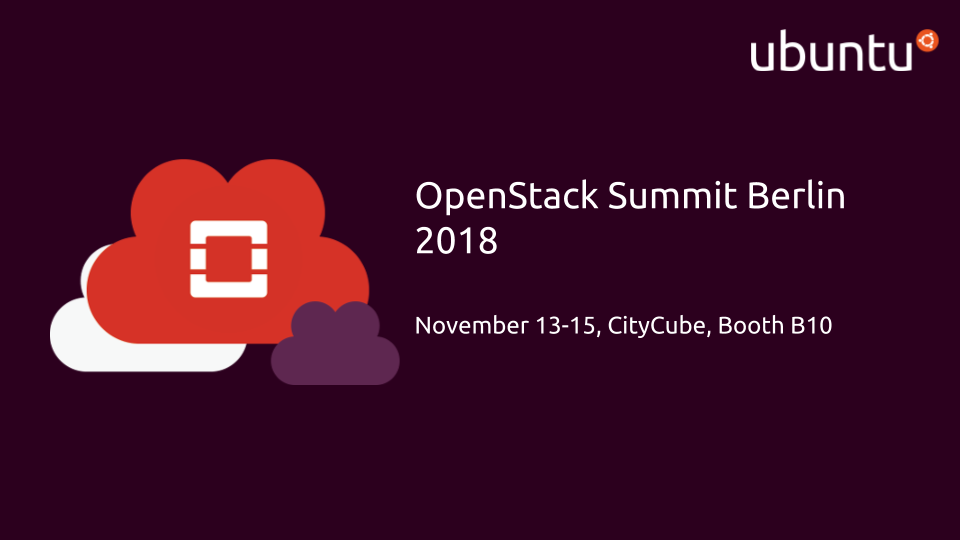
Event Details Date: November 13 – 15, 2018 Location: Berlin, Germany Venue: CityCube Booth: B10 OpenStack Summit Berlin Canonical, the company behind Ubuntu, is headlining the main event of the season, OpenStack Summit Berlin, November 13 – 15, 2018. As a founding member, we are passionate about OpenStack and talking to its users about th

Canonical is pleased to share that it’s TechOps team has successfully completed the MSP Cloud Verify Program (MSPCV) certification process which recognises the quality of companies offering cloud and/or managed services. The MSPCV, conducted by the MSPAlliance, is based on the Unified Certification Standard (UCS) for Cloud and Managed Ser

November is just around the corner, winter jumpers are being dug out from the back of the wardrobe and it’s now acceptable to put the heating on. Although many may be considering hibernation, the Ubuntu team here at Canonical will be out and about around the world at a number of big events. So

Coinciding with the release of Ubuntu 18.10 today, we have celebrated the exceptional adoption of snaps by sharing the infographic below. From popular snaps to daily installs, this infographic demonstrates where, when and why users are installing and adopting the secure, Linux application format. For more commentary around these numbers,